
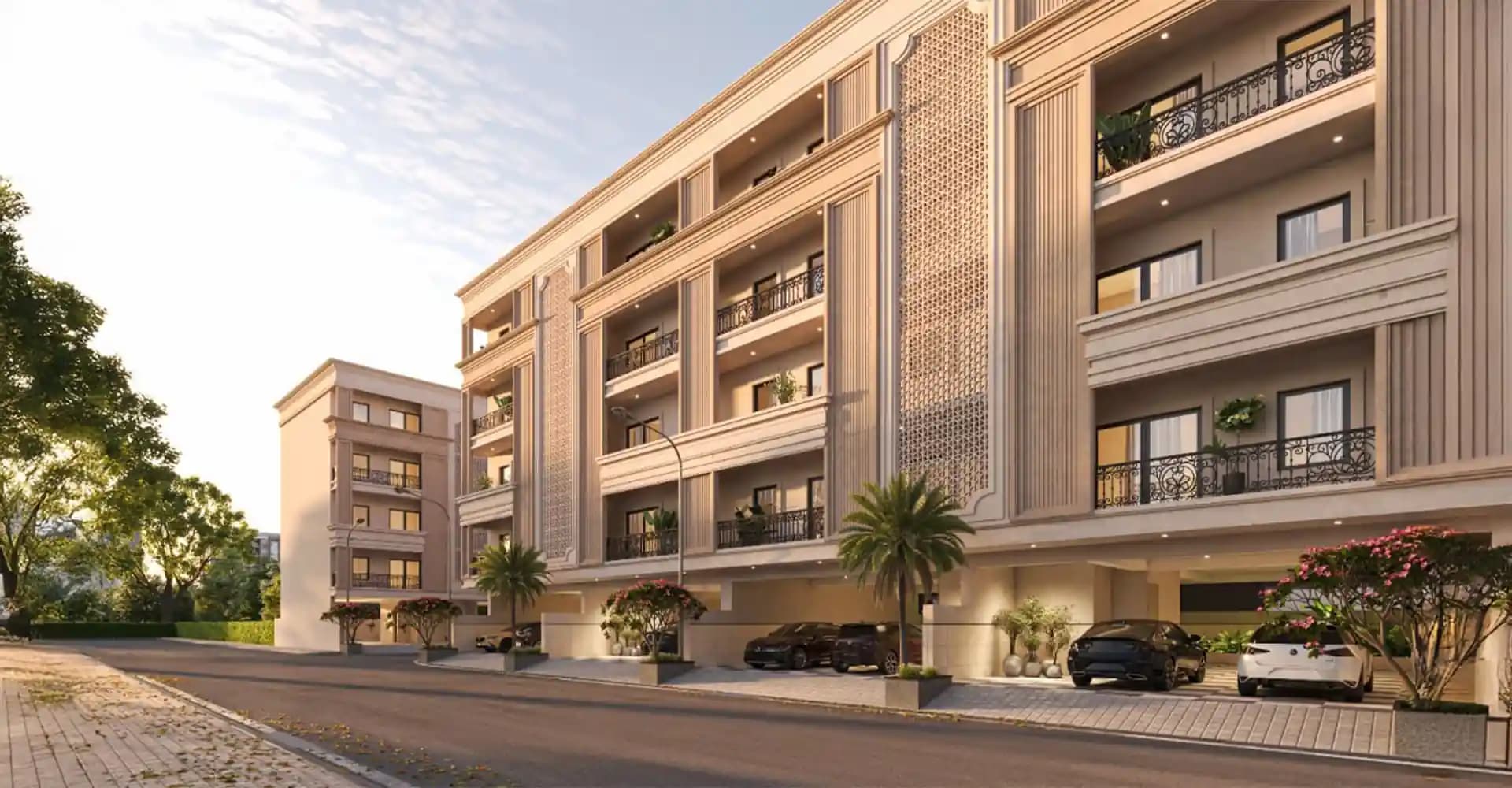
01What Is a Builder Floor — And Why Gurgaon Loves Them
If there's one city in India that has truly reinvented itself in the last two decades, it's Gurgaon — officially known as Gurugram. What was once agricultural land is now India’s most electrifying real estate market, making it the perfect time to buy apartment in gurgaon.
A builder floor is an independent residential unit occupying a single floor of a low-rise building — typically 3 to 4 storeys — built on a privately owned plot. Each floor is independently owned by a separate family. There's no 200-unit tower, no overcrowded elevator lobby, no society WhatsApp group blowing up about parking.
In Gurgaon, builder floors are most commonly found across DLF Phases 1–5, Sushant Lok, South City, Sector 40, 45, 52, 55, 57, 63A, and 67. The format reflects the city's unique evolution — HUDA/DTCP originally allotted plots to individual buyers who developed them floor by floor, with each storey sold independently. Over time, this became one of the most preferred residential formats in NCR.
What makes a builder floor genuinely different is the land component. When you buy a builder floor in Gurgaon, you're not just buying a unit inside a building — you're buying a proportionate undivided share (UDS) of the plot beneath it. In a land-scarce, rapidly-appreciating market like Gurgaon, that distinction matters enormously.
02Builder Floor vs Apartment vs Kothi — The Honest Comparison
This is the question every Gurgaon property buyer eventually wrestles with—here’s an honest, no-fluff breakdown to help you understand the property price in Gurgaon.
🏢 High-Rise Apartment
The Good
- Full amenity ecosystem — pool, gym, clubhouse, round-the-clock security
- RERA-registered (mostly), so legal transparency is higher
- Strong rental demand from young professionals and corporates
- Easier and faster home loan approval from banks
- Easier to resell — standardised pricing, broader buyer base
The Not-So-Good
- You own a unit inside a building, not land. Land appreciation doesn't directly benefit you.
- Monthly maintenance can run ₹8,000–₹25,000+, eating into net rental yield
- 200+ families sharing lobbies, lifts, amenities — privacy is limited
- Builder delays are common. Possession can stretch years in under-construction projects.
🏡 Independent House / Kothi
The Good
- Complete ownership of both land and building
- Full control over design, construction, and future expansion
- Maximum privacy — this is as close to your own kingdom as it gets
- Highest long-term capital appreciation
The Not-So-Good
- Prohibitively expensive — good kothis in DLF Phase 1 now start at ₹10–₹30 Cr+
- All maintenance, security, and upkeep fall entirely on you
- Not always liquid — can take longer to find the right buyer at the right price
🏠 Builder Floor — The Gurgaon Middle Path
The Good
- You own your floor plus a proportionate share of the underlying land (UDS)
- Land appreciation in Gurgaon works directly in your favour
- Only 3–4 families per building — vastly more private than apartments
- Lower entry point than a full kothi, with similar land ownership benefits
- Individual utility meters (electricity, water) — you're not subsidising someone else's bills
- Customisation possible within your floor
The Not-So-Good
- No clubhouse, pool, or gym unless nearby
- Common area upkeep can become a dispute between co-owners without a written agreement
- Legal documentation is more complex than apartments — requires thorough title verification
- Home loan approval requires additional documentation checks
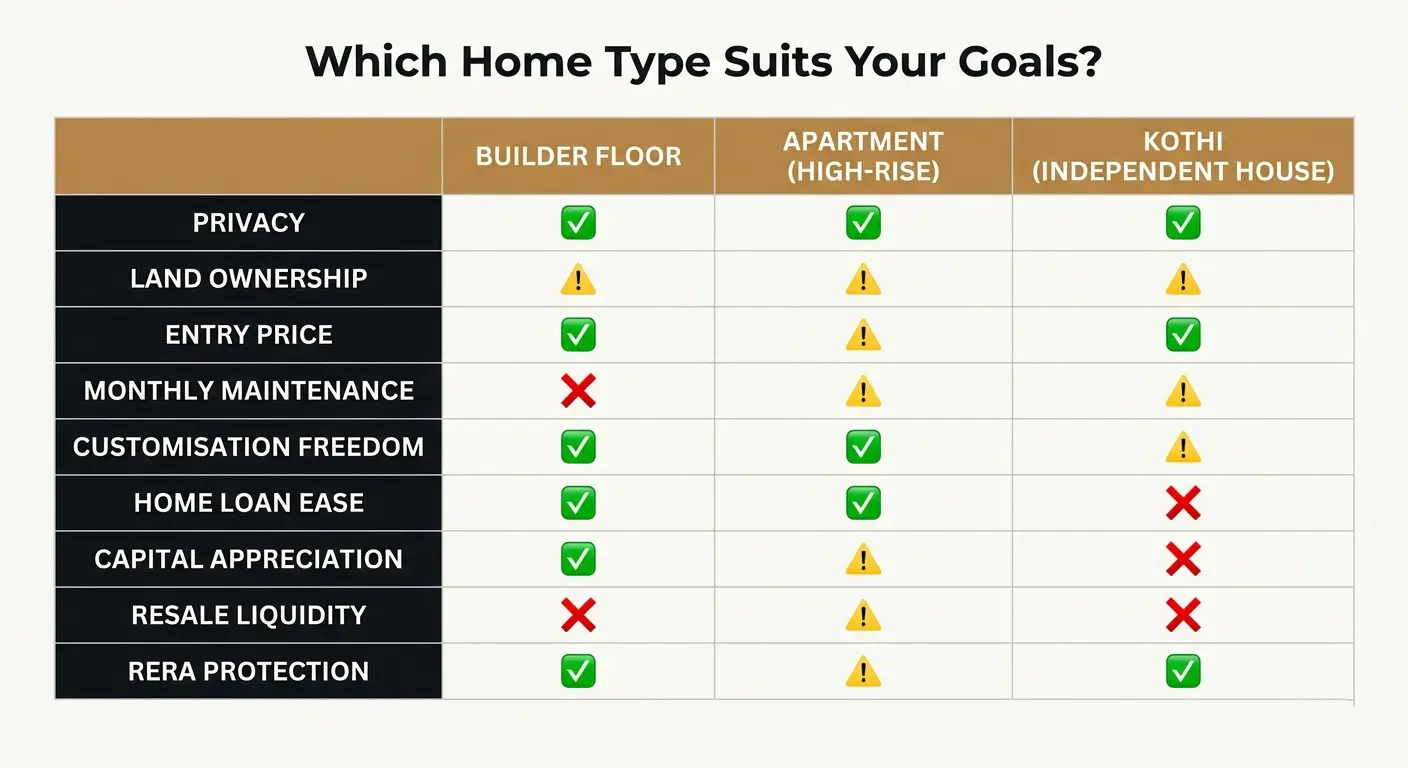
Which Home Type Suits Your Goals? — A three-way comparison
03Types of Builder Floors — Stilt+4 and Everything Else
Not all builder floors are created equal—the type you choose directly impacts your lifestyle, legal rights, and resale value, which is crucial to understand when searching for an affordable builder floor in Gurgaon, especially after the major 2024 policy changes that reshaped the market.
🏗️ Stilt + 4 — The Current Legal Maximum
On July 2, 2024, the Haryana government formally permitted Stilt+4 construction — four independent floors above a stilt-level parking area — across approved residential colonies in Gurgaon. This remains the governing policy as of 2026.
| Rule | Detail |
|---|---|
| High-Density Layouts (18 persons/plot) | Stilt+4 permitted for all plots regardless of road width |
| Low-Density Layouts (13.5 persons/plot) | Stilt+4 only if plot fronts a road of 10 metres or wider |
| 9-Metre Roads (low-density) | Capped at Stilt+3 — four floors not permitted |
| Neighbour Consent | Irrevocable mutual consent from adjoining plot owners required |
| 1.8-Metre Setback Alternative | If neighbour refuses NOC, maintain 1.8m side setback on all floors |
| Stilt Enclosure | Zero tolerance — partial enclosure = OC deemed withdrawn |
| Basement | Only permitted on plots 250 sq metres or larger |
🏗️ DDJAY Plots — A Special Category
- Stilt+4 permitted regardless of road width (9m or 12m), provided density requirements are met
- No neighbour NOC required
- If originally licensed at 13.5 persons/plot, developer must revise density to 18 persons/plot before constructing four floors
📐 Stilt + 3 — Established Buildings Pre-2024
Many well-located buildings in established colonies follow the older Stilt+3 format. These are fully legal, well-maintained, and often in prime sectors. The lower height actually makes them preferable for some buyers who want a quieter building.
🏚️ G+2 / G+3 — Old Colony Format
Older sectors have buildings without a formal stilt level — parking is surface-level or informal. Cheaper to buy but require extra documentation scrutiny.
04Best Sectors & Localities in Gurgaon — 2026 Price Guide
Location is everything in Gurgaon. Here's a frank, locality-by-locality breakdown with 2025–2026 price data.
🥇 Premium Tier — Established Strongholds
| Locality | Total Price (3–4 BHK) | Circle Rate | Key Advantage |
|---|---|---|---|
| DLF Phase 1 & 2 | ₹6.5 Cr – ₹10 Cr | ₹77,000/sq yd | Prestige address, CyberHub proximity |
| DLF Phase 3 & 4 | ₹5 Cr – ₹9 Cr | ₹66,000–₹72,000/sq yd | Established, Galleria Market access |
| Golf Course Road | ₹8 Cr – ₹15 Cr | Premium | Ultra-luxury belt, expat rental demand |
| Sushant Lok Phase 1 | ₹4 Cr – ₹8 Cr | ₹77,000/sq yd | Mature neighbourhood, Metro accessible |
🥈 Mid-Premium Tier — Best Value Picks
| Locality | Total Price (3–4 BHK) | Circle Rate | Why It Works |
|---|---|---|---|
| South City 1 & 2 | ₹3 Cr – ₹7 Cr | ₹72,000/sq yd | Wide roads, established schools |
| Sector 55 & 57 | ₹3.5 Cr – ₹6 Cr | — | Fastest-developing near Golf Course Ext. |
| Sector 52 | ₹3 Cr – ₹5.5 Cr | — | Metro proximity, strong rental market |
| Nirvana Country / DLF Phase 5 | ₹4 Cr – ₹7 Cr | ₹61,000/sq yd | Greenery, upscale colony feel |
🥉 Growth Tier — Where Smart Money is Moving
| Locality | Total Price | Why It Works |
|---|---|---|
| Sector 63A (Golf Course Ext. Road) | ₹3 Cr – ₹7 Cr | Ultra-luxury hub, strong expat demand |
| Sector 67 & 70A | ₹2.5 Cr – ₹5 Cr | Emerging premium, new infrastructure |
| Sector 79, 89A | ₹1 Cr – ₹3 Cr | DDJAY-backed, RERA-registered plots |
| Sohna Road Belt | ₹80 L – ₹2.5 Cr | Fastest-growing micro-market, DDJAY zone |
05The True Cost of Buying a Builder Floor — BSP, PLC, EDC & More
The biggest surprise for first-time buyers is that the quoted price is only the starting point, as the total cost typically rises by 20–30% above the base price once all charges are included—something crucial to understand when looking for an affordable builder floor in Gurgaon.
💰Base Selling Price (BSP)
The headline number. Always quoted per sq ft on super area — which includes walls, common passages, and structural elements. Your actual usable (carpet) area will be 15–25% less than the super area figure.
📍PLC — Preferential Location Charges
Corner plot: +3–5% | Park-facing: +3–5% | East/North-facing (Vastu preferred): +2–4% | Wide road facing: +2–3%
🏗️EDC — External Development Charges (2026 UPDATE)
The Haryana government approved a 20% hike effective January 1, 2025, followed by 10% annual increases from 2026 onwards. EDC now accounts for approximately 7–8% of total project cost. Developers are passing this on to buyers.
🔧IDC — Infrastructure Development Charges
Collected to fund state-level infrastructure. In DDJAY projects, IDC is fully waived. In standard licensed colonies, IDC is calculated as a percentage of EDC.
📦IFMS — Interest-Free Maintenance Security
A one-time deposit for future common area maintenance. Ranges from ₹50,000–₹2,00,000. This is your money held in trust — always get a receipt.
🧾 All-In Cost Estimate
| Cost Head | Indicative % of BSP |
|---|---|
| BSP | 100% |
| PLC | +3–8% |
| EDC + IDC (post-2025 hike) | +7–12% |
| IFMS + Club | +1–2% |
| Stamp Duty & Registration | +5–7% (gender-dependent) |
| Legal / Misc | +1–2% |
| Total Effective Cost | ~120–130% of BSP |
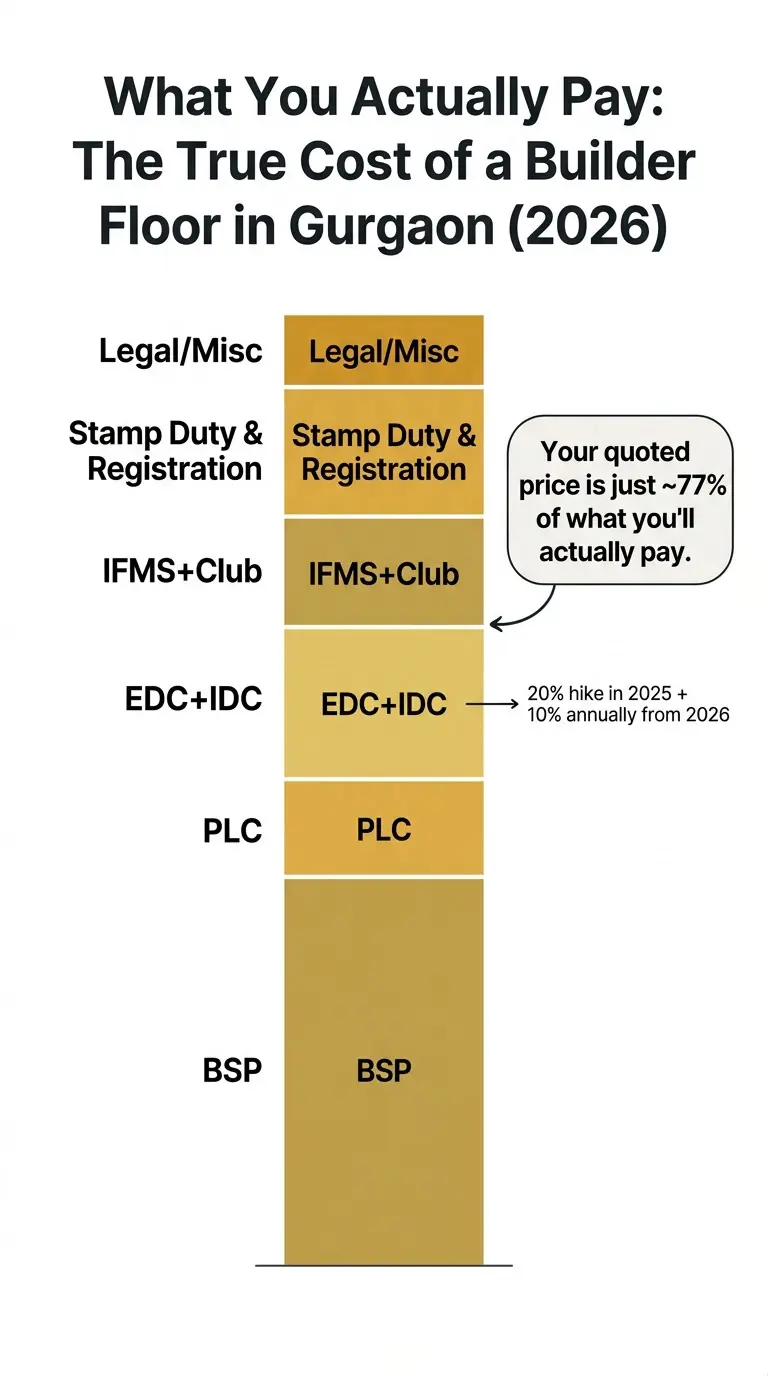
What You Actually Pay: The True Cost of a Builder Floor in Gurgaon (2026)
06Legal Documentation — The Chain That Cannot Break
This is where most buyer nightmares begin—and where many could have been avoided, as a builder floor on a privately owned plot often comes with a complex document history where every link in the chain matters, especially when evaluating the true property price in Gurgaon.
1Allotment Letter
The genesis document. Issued by HUDA/DTCP to the first buyer. Contains plot dimensions, sector, usage type, and allotment conditions. If this is missing or incomplete, the entire chain is questionable.
2Conveyance Deed / First Registry
The formal transfer of ownership from HUDA or the original developer to the first buyer — registered with the sub-registrar. If this document is missing, walk away.
3All Subsequent Sale Deeds
Every ownership transfer since the allotment must have a registered sale deed. One missing link is enough to block a home loan or create a resale dispute decades later.
4Building Plan Approval / Sanctioned Plan
Issued by MCG or DTCP. Shows what construction is legally authorised — number of floors, setbacks, FAR. Compare the approved plan to the actual building. Any major discrepancy = serious red flag.
5Completion Certificate (CC)
Confirms that construction has been completed as per the approved plan and all zoning rules. Issued by the relevant municipal authority.
6Occupancy Certificate (OC)
The Occupancy Certificate (OC) is the most critical document, as it certifies that the building is safe, habitable, and connected to civic utilities; without it, most banks won’t approve a home loan, living there can be considered a bylaw violation, and the property may even face sealing or demolition—making it essential to verify when assessing the true property price in Gurgaon.
7Collaboration Deed (If Applicable)
If the builder developed floors on someone else's plot, there must be a registered collaboration deed between the landowner and builder. This defines floor-wise ownership, sale proceeds distribution, and responsibilities.
8Encumbrance Certificate (EC)
Obtained from the sub-registrar's office. Lists every registered transaction on the property — mortgages, loans, legal disputes. Always get EC for a minimum of 30 years.
9Property Tax Receipts
Unpaid MCG property tax becomes the new owner's liability. Insist on all receipts up to the current year before transfer.
10Haryana Jamabandi Records
Before finalising registration, verify the property's status on the Haryana Jamabandi portal (jamabandi.nic.in) — confirm mutation records, ownership history, and that no pending legal dues exist.
11Utility Connection Letters
Copies of DHBVN electricity connection and MCG/HUDA water connection documents in the seller's name. Verify these are transferable.
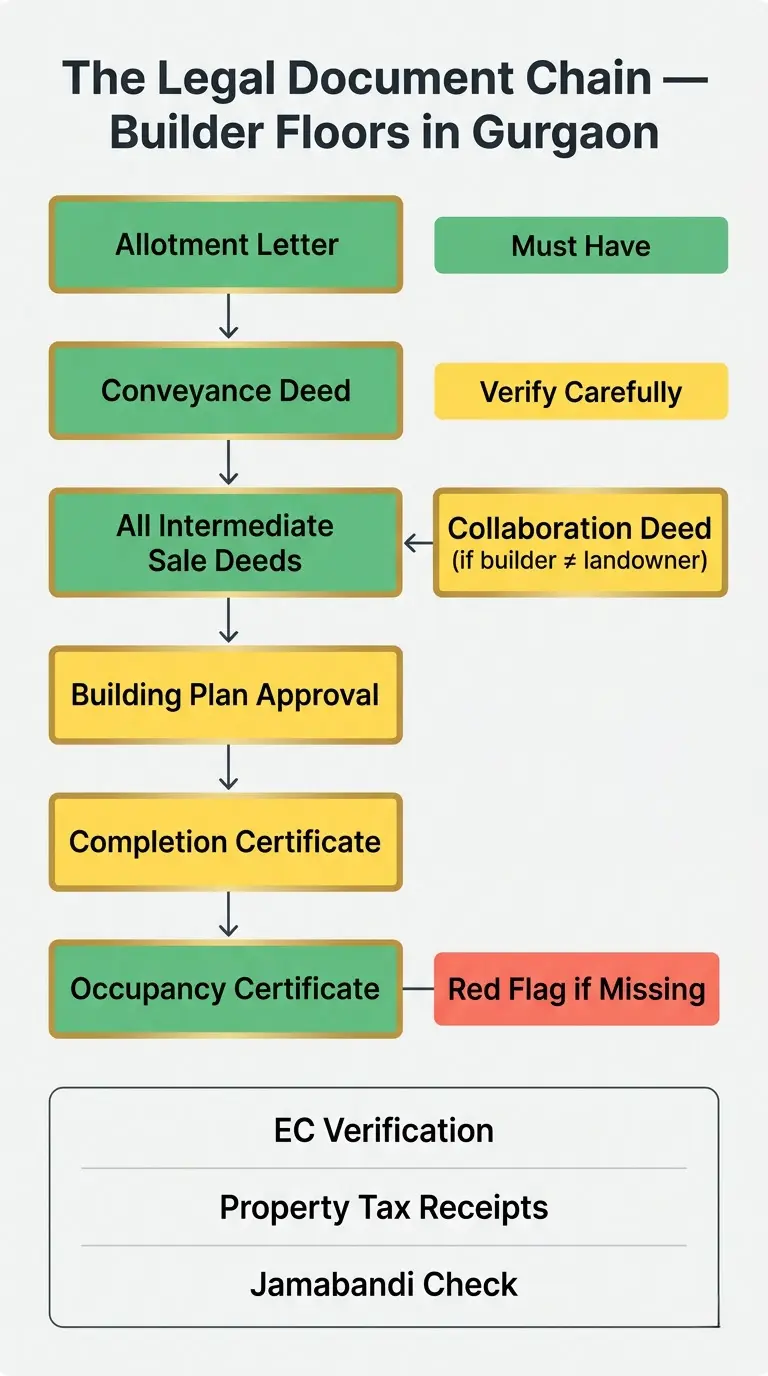
The Legal Document Chain — from Allotment Letter to Occupancy Certificate
07RERA, H-RERA & Builder Floors — What the Law Actually Says
RERA (Real Estate Regulation and Development Act) was designed to protect buyers from developer defaults. But its applicability to builder floors in Gurgaon is more nuanced than most people realise.
When H-RERA Applies
H-RERA registration is mandatory when:
- A promoter (builder/developer as a company or firm) develops a project with more than 8 units
- Development involves land exceeding 500 sq metres
- The promoter is a registered legal entity — not an individual landowner
When H-RERA typically does not apply:
- An individual landowner building 3–4 floors on their private plot and selling independently
- “Self-built” units developed by a single family and sold without a company promoter structure
What H-RERA Compliance Brings (2025–2026)
| Protection | Details |
|---|---|
| 5-Year Defect Liability | Structural defects reported within 5 years of possession rectified free of charge within 90 days |
| Escrow Protection | 70% of amounts collected from buyers held in dedicated escrow, used only for that project |
| Promoter Maintenance Obligation | Developer maintains all services for 5 years after CC or until Association takes over |
| Full Transparency | Complete project disclosures, timeline commitments, and financial accountability publicly visible |
08Affordable Housing Builder Floors in Gurgaon — Complete Guide
Affordable housing builder floors in Gurgaon exist primarily in the Sohna, Pataudi, and New Gurgaon (Sectors 76–95) belt, and they operate under a government-regulated framework that offers genuine buyer protections and financial benefits.
📍 Where Are Affordable Builder Floors Located?
| Location | Type | Why Here |
|---|---|---|
| Sohna | DDJAY plotted colonies | Primary hub, multiple active projects |
| Pataudi | DDJAY plotted colonies | Lower land cost, emerging connectivity |
| Sohna Road Belt | Mixed affordable | Fast-growing corridor, improving infrastructure |
| New Gurgaon (Sectors 76–95) | Mixed affordable | More moderate land costs vs Golf Course belt |
🏛️ PMAY 2.0 — Who Actually Benefits?
PMAY-U 2.0 was launched in September 2024, targeting one crore urban families with home loan interest subsidies. As of February 2026, over 10 lakh houses have been sanctioned nationally.
| Category | Annual Household Income | Max Loan for Subsidy |
|---|---|---|
| EWS (Economically Weaker Section) | Up to ₹3 lakh | Up to ₹6 lakh |
| LIG (Low Income Group) | ₹3 lakh – ₹6 lakh | Up to ₹6 lakh |
| MIG (Middle Income Group) | ₹6 lakh – ₹9 lakh | Up to ₹9–12 lakh |
09DDJAY Builder Floors — The Complete Guide
If there’s one scheme that has truly democratized independent floor ownership in the Gurgaon–Sohna belt, it’s the Deen Dayal Jan Awas Yojana (DDJAY), launched by the Haryana government in 2016, creating a new category of buyers—middle-income families who want land ownership, independent living, and strong investment potential without the ₹5 Cr+ price tag, making it an excellent opportunity for those looking to buy builder floor in gurgaon.
| Parameter | DDJAY | Regular Licensed Colony |
|---|---|---|
| IDC | Fully Waived | Applicable |
| EDC | Significantly Reduced | Full rate (+20% hike from Jan 2025, +10% yearly from 2026) |
| RERA Status | Mandatory | Often not applicable |
| Neighbour NOC for S+4 | Not Required | Required on roads <10m |
| Bank Financing | Easier — proactive bank support | Depends strictly on OC/CC |
| Plot Sizes | 60–150 sq yards | Varies |
🔄 The DDJAY Investment Model — Live & Earn
Buy a 100–150 sq yard DDJAY plot in Sohna at ₹40–₹80 lakhs
Construct Stilt+4 (₹5,000–₹7,000/sq ft for quality build)
Register each floor independently under separate sale deeds
Live on one floor, rent out 3 floors — three independent rental incomes from one plot
Land appreciates underneath — rental yield + capital gains simultaneously
⚠️ What to Watch Out For in DDJAY Projects
- Verify H-RERA number on hrera.org.in before booking anything
- Confirm density approval — check if project has received 18 persons/plot clearance for S+4
- Check plot size — must be 60–150 sq yards; outside this range = not standard DDJAY
- Developer track record — RERA registration is necessary but not sufficient; check past delivery history
- Infrastructure status on ground — visit the site; roads, sewage, electricity timelines vary project to project
10Stamp Duty, Registration & Home Loans in 2026
🧾 Stamp Duty in Haryana — Current Rates
| Buyer Category | Stamp Duty | Registration Fee | Total |
|---|---|---|---|
| Male | 5% | 2% | 7% |
| Female | 3% | 2% | 5% |
| Joint (Male + Female) | 4% | 2% | 6% |
🏦 Home Loans for Builder Floors
Getting a home loan on a builder floor is absolutely possible, but it’s more complex than financing a RERA-registered apartment, making expert guidance essential when you plan to buy builder floor in gurgaon.
Banks that finance builder floors (2026): SBI, HDFC Bank, ICICI Bank, Axis Bank, PNB Housing Finance, LIC HFL
Non-negotiable requirements:
- Complete and unbroken ownership chain (all sale deeds)
- Valid Building Plan Approval from DTCP/MCG
- Occupancy Certificate (OC) — most banks will not disburse without this
- No encumbrance on the property (clean EC)
- Property tax paid up to date
Common reasons for home loan rejection on builder floors:
- Missing OC or CC
- Unauthorised additional construction (covered stilt, illegal extra floor)
- Missing sale deeds in ownership chain
- Property on agricultural/lal dora land without CLU
- Illegal enclosure of stilt parking area
11Ownership Rights — Terrace, Stilt, Basement & Your UDS
One of the most disputed aspects of builder floor living. Clarity here prevents years of neighbour conflicts.
Your Floor
You own that floor's carpet area exclusively, as documented in your sale deed.
UDS — Undivided Share of Land
You own a proportionate undivided share of the plot. In a Stilt+4 building on a 200 sq yd plot, each of the four floor owners typically holds ~25% UDS. This is what makes a builder floor a land asset — not just a building asset. In Gurgaon's appreciating market, this is where the real long-term wealth is created.
Terrace Rights
Top floor owner typically gets exclusive terrace rights. This must be explicitly mentioned in your sale deed — verify before signing. Exceptions: lift machine rooms, water tanks, and shared infrastructure remain common property. Terrace rights add significant premium to top floor resale value.
Stilt Parking
Strictly for parking only — zero exceptions under current Haryana building bylaws. Enclosing the stilt (even with a grill gate) can result in OC cancellation. Each floor owner typically gets one designated stilt parking spot — get allocation confirmed in writing.
Basement
Only permitted on plots of 250 sq metres or larger (per 2024 amendments). May be attached to the ground floor or sold as a separate storage unit. Verify FAR usage compliance for the specific sector.
Common Areas
Staircase, entrance lobby, and building facade are shared equally by all floor owners. Maintenance responsibilities must be defined in writing — ideally in a co-ownership agreement signed by all floor owners at the time of purchase.
12Construction Quality — What to Inspect Before You Buy
Unlike buying from a branded developer, purchasing a builder floor from an individual seller requires you to physically verify construction quality, so having a room-by-room inspection framework is essential when you plan to buy builder floor in gurgaon.
🔍 Structural Checks
- Verify it is a proper Reinforced Cement Concrete framed structure — not load-bearing brick
- For Stilt+4 buildings: confirm the foundation was designed for four floors from the start, not incrementally upgraded
- Ask for a structural design certificate if possible
- Minimum slab thickness: 125mm for residential use
🔍 Room-by-Room Inspection
| Room | What to Check |
|---|---|
| Living/Dining | Cracks in walls or ceiling, hollow spots in flooring tiles, electrical concealment |
| Bedrooms | Damp patches on walls adjacent to bathrooms or external walls, adequate plug points, cross-ventilation |
| Kitchen | Water pressure from taps, under-sink plumbing leaks, exhaust ventilation |
| Bathrooms | Waterproofing on all walls and floor for seepage, CPVC or UPVC pipes (better than GI), drainage speed |
| Terrace (Top Floor) | Waterproofing membrane condition, seepage tracks on the ceiling of the floor below |
| Stilt/Parking | Confirm not enclosed or partially converted, verify allocated parking spot |
13Investment Potential — Rental Yield, ROI & Appreciation in 2026
Two assets appreciate simultaneously: In a builder floor, you own your floor unit AND a proportionate share of the land. In Gurgaon, land prices escalate every 3–4 months in prime sectors — and that appreciation directly benefits builder floor owners in a way it never does for apartment buyers.
🏡 Rental Yield by Locality — 2026 Data
| Locality | Monthly Rent (3BHK Floor) | Gross Rental Yield |
|---|---|---|
| DLF Phase 1 | ₹70,000 – ₹1,10,000 | ~6% (Phase 1 leads all DLF phases) |
| DLF Phase 2, 4, 5 | ₹60,000 – ₹1,50,000 | ~3% |
| Golf Course Road | ₹1,00,000 – ₹2,00,000 | ~3–3.5% |
| Sushant Lok / Sector 55–57 | ₹40,000 – ₹90,000 | ~3–4% |
| Sector 52, 63A | ₹35,000 – ₹70,000 | ~3.5–4.5% |
| Sohna Road Belt | ₹15,000 – ₹35,000 | ~3.5–5% |
📊 Capital Appreciation — The 5-Year Story
| Factor | Builder Floor | Society Apartment |
|---|---|---|
| Capital Appreciation | Higher (land + building) | Moderate (building only) |
| Gross Rental Yield | Comparable | Comparable |
| Monthly Maintenance Cost | ₹1,000–₹2,000 | ₹5,000–₹25,000+ |
| Net Rental Yield | Higher (lower maintenance) | Lower (maintenance eats yield) |
| Resale Liquidity | Moderate (niche buyer) | Higher (broader market) |
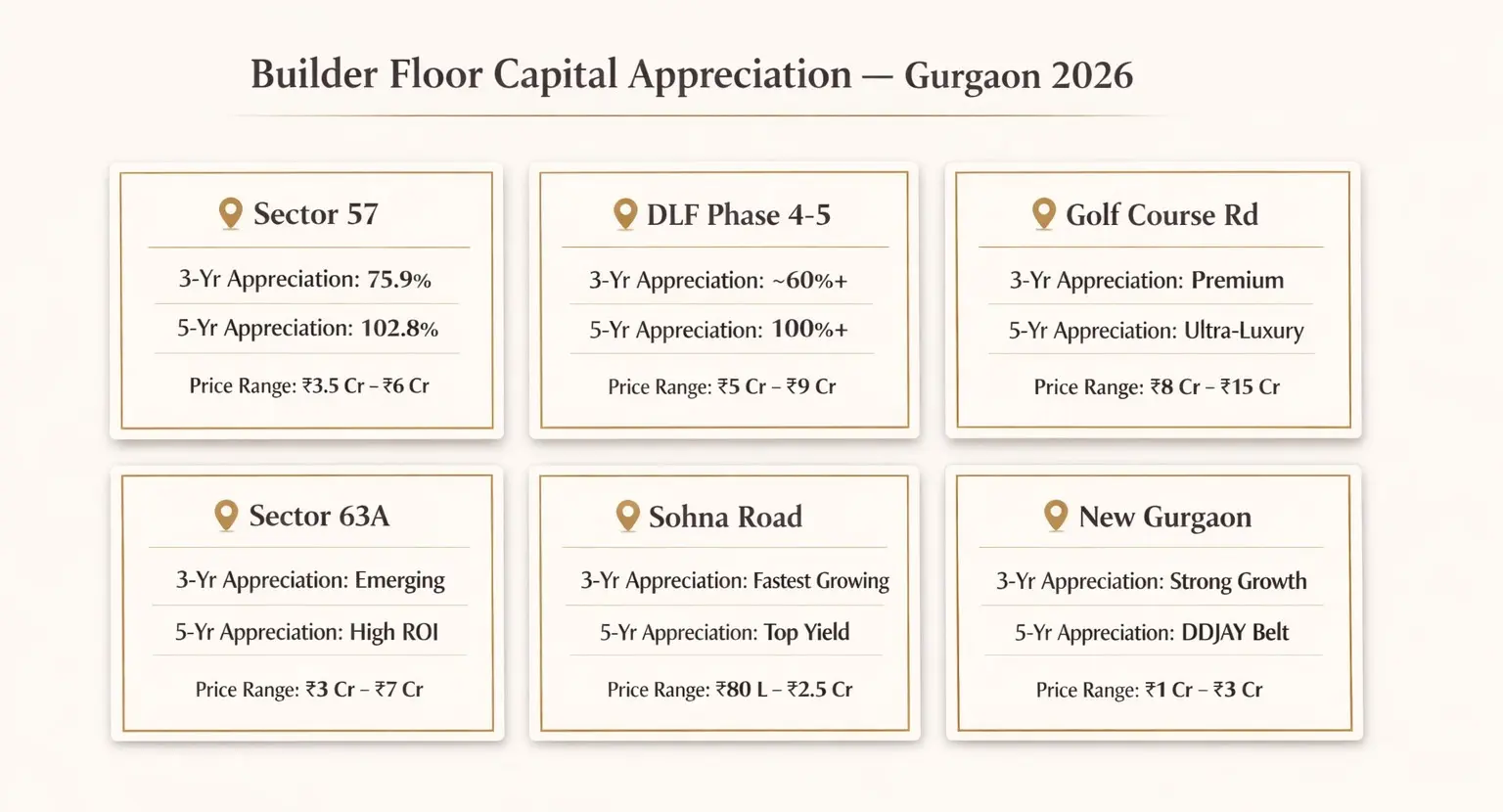
Builder Floor Capital Appreciation — Gurgaon 2026. Source: Market data 2026 | dobighazam.in
14Red Flags & Scams — The Things That Cost Buyers Crores
This section exists because the most expensive mistakes in real estate are entirely avoidable. Read this carefully before you put down a token amount on anything.
Red Flag 1: No Occupancy Certificate
Never buy a builder floor without an OC. Full stop. If the seller says 'OC is in process,' 'OC is not required for this type of property,' or 'other buyers haven't asked for it' — treat these as serious warning signs. Without OC: most banks reject your home loan, living there is technically a building bylaw violation, and the property could face sealing or demolition notice from MCG.
Red Flag 2: Stilt Area Enclosed
If the stilt parking area has been converted into a room, storage, shop, or even partially enclosed with a grill — this is illegal. Under the post-July 2024 amendments, enclosure of the stilt area causes the building plan approval and OC to be deemed withdrawn. Do not buy such a property unless the seller formally rectifies this before transfer.
Red Flag 3: Power of Attorney (PoA) Sale Instead of Sale Deed
Many builder floors in Gurgaon change hands through General Power of Attorney (GPA) rather than registered sale deeds. The Supreme Court of India has explicitly ruled that GPA is not a substitute for proper conveyance. PoA can be revoked at any time without your knowledge. Always insist on a registered sale deed.
Red Flag 4: Gaps in the Ownership Chain
Even one missing sale deed in the chain can block your home loan, invite legal challenges from heirs of previous owners, and create problems at resale. Get the Encumbrance Certificate for 30 years and cross-reference every transaction.
Red Flag 5: Construction Doesn't Match Approved Plan
Get the sanctioned building plan from the seller and physically compare it to the actual structure. Unauthorised additional rooms, floors added after OC, or covered setbacks are extremely common in Gurgaon. These cannot be regularised easily and will cause issues when you try to sell.
Red Flag 6: Agricultural Land Without CLU
Plots on the fringes of Gurgaon may be agricultural land without a valid Change of Land Use (CLU) certificate. Buying residential construction on non-CLU land carries very high legal risk — the property can face government action at any time.
Red Flag 7: Price Dramatically Below Market
A builder floor in DLF Phase 1 for ₹2 Cr when the market rate is ₹7 Cr is not a deal — it's a trap. There will always be a reason. Title disputes, illegal construction, a PoA-based transfer, or outright fraud are the usual culprits.
15Vastu for Builder Floors — Market Preferences in Gurgaon
Vastu Shastra remains a deeply influential consideration for the majority of Indian homebuyers in Gurgaon. Here are the broad market preferences that directly impact pricing and demand.
Main Entrance Direction
| Direction | Vastu Status | Market Impact |
|---|---|---|
| North-East | Most auspicious | Highest demand, premium pricing |
| North | Very auspicious | High demand |
| East | Auspicious | High demand |
| North-West | Neutral-positive | Good demand |
| South-East | Acceptable with remedies | Moderate demand |
| South | Needs remedies | Lower preference |
| South-West | Generally avoided | Lowest demand |
Room Placement Preferences
| Room | Preferred Location | Rationale |
|---|---|---|
| Master Bedroom | South-West | Stability and long-term wellbeing |
| Kitchen | South-East | Fire element alignment |
| Pooja / Prayer Room | North-East | Divine energy corner |
| Guest Room | North-West | Encourages temporary stay |
| Study / Home Office | North or East | Clarity and focus |
| Toilets | North-West or South | Away from sacred corners |
16Alternatives Worth Considering
If the complexity of builder floor documentation feels daunting, or if you want land ownership with the security of RERA compliance, plotted developments deserve serious consideration. Alternatively, if amenities and branded security matter more than privacy, Gurgaon's luxury apartment market has compelling offerings.
Properties Worth Comparing
Explore builder floor alternatives — from DDJAY plots to luxury apartments — all with transparent pricing.
LID Nivasa
DDJAY Plot · Sohna
RERA-backed plotted development. Build your own Stilt+4 floors.
Green Valley Homes
DDJAY Plot · Sohna
Township-format plotted project. Land ownership, your terms.
Silverglades The Legacy
Luxury Apartment · Sector 63A
Ultra-luxury 3–5 BHK. The apartment alternative at builder floor price points.
First Citizen by Silverglades
Premium Apartment · Gurgaon
Brand reliability + consistent quality from the Silverglades Group.
IREO The Corridors
Premium Apartment · Sector 67A
Golf Course Ext. Road. Strong rental demand from corporate catchment.
Ashiana Mulberry
Senior Living · Sohna
Multi-generational living option. Trusted Ashiana Group quality.
The Melia by Silverglades
Mid-Premium · Sohna
Branded quality in Sohna's high-growth corridor.
17Final Master Checklist Before You Sign Anything
You’ve found the floor, you love it, and the price feels right—but before you pay even a single rupee as a token, make sure you go through this complete checklist, especially when finalizing an affordable builder floor in Gurgaon.
Part A — Document Verification (Before Token Payment)
- Allotment letter present and matches current plot details
- Conveyance deed / first registry present and registered
- All subsequent sale deeds in chain — none missing
- Encumbrance Certificate obtained for 30 years — no dues or mortgages
- Building Plan Approval obtained — matches actual construction
- Completion Certificate (CC) available
- Occupancy Certificate (OC) available — do not proceed without this
- Property tax receipts paid up to current year
- Collaboration deed present (if builder ≠ landowner)
- Jamabandi records verified online (jamabandi.nic.in)
- CLU available if property is on converted/agricultural land
Part B — Physical Inspection
- Independent structural engineer inspection completed
- Actual construction matches sanctioned building plan
- Stilt parking area is open — not enclosed or converted
- No illegal additional floors, rooms, or covered setbacks
- Waterproofing intact — no seepage/damp on walls, ceiling, or terrace
- Individual electricity meter (DHBVN) confirmed for your floor
- Individual water connection confirmed for your floor
- DHBVN pending dues on the plot — verify there are none
Part C — Financial Clarity
- Full cost sheet obtained in writing: BSP + PLC + EDC/IDC + IFMS + legal
- EDC/IDC inclusion confirmed — or amount and liability clearly defined
- Stamp duty budget calculated (5–7% depending on buyer gender)
- Bank pre-approval for home loan completed (if applicable)
- No undisclosed charges in the sale agreement
Part D — Agreement & Rights
- Sale deed (not GPA) — insist on registered sale deed
- UDS (land share) clearly mentioned in sale deed
- Terrace rights explicitly stated in sale deed (if top floor)
- Stilt parking spot allocation confirmed in writing
- Basement usage defined (if applicable)
- Co-ownership maintenance agreement drafted with all floor owners
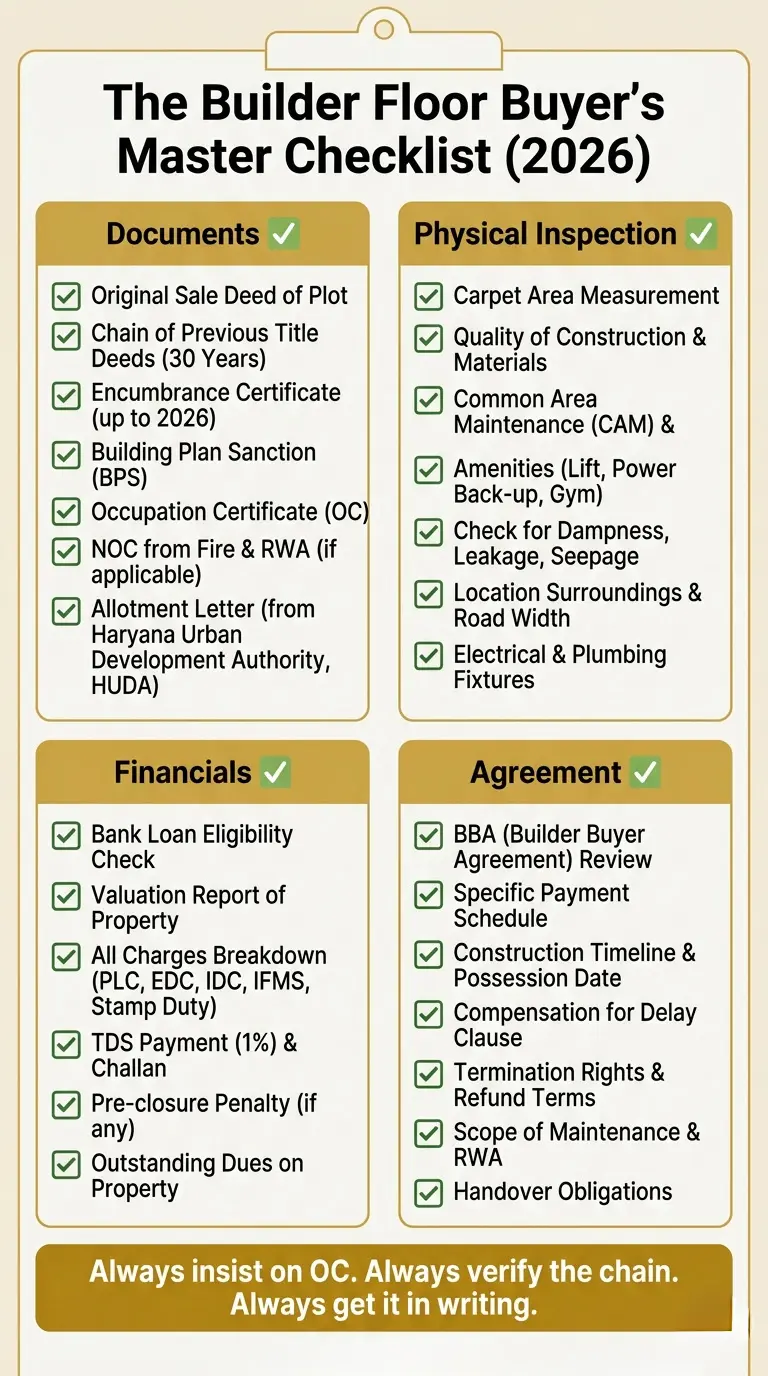
The Builder Floor Buyer's Master Checklist (2026) — Always insist on OC. Always verify the chain. Always get it in writing.
10 Key Takeaways
- 01
Builder floors give you land + building — making long-term appreciation stronger than apartments in Gurgaon's land-scarce market.
- 02
EDC has been hiked 20% from January 2025, with 10% annual increases from 2026 — factor this into your total cost calculations.
- 03
Stilt+4 is the legal maximum — governed by road width, density classification, and neighbour consent rules under the Haryana Building Code.
- 04
OC is non-negotiable — no OC means no home loan, no legal habitation, and significant resale risk.
- 05
The true all-in cost is 20–30% above BSP — always get a full cost sheet before agreeing to any price.
- 06
DDJAY plotted developments offer RERA-backed land ownership at accessible entry prices — a compelling alternative worth evaluating.
- 07
Gurgaon's rental yield averages 4.1% — the highest in NCR — with DLF Phase 1 delivering up to 6% gross yield.
- 08
Sector 57 has appreciated 102.8% in five years — builder floors in growth corridors have been exceptional wealth creators.
- 09
A ₹10,000–₹15,000 structural inspection can save you crores in legal and repair costs later.
- 10
Never accept a GPA sale — always insist on a registered sale deed.
Ready to Find Your Right Property?
Buying a home is one of the most important financial decisions of your life, and our advisors offer free, honest consultations with no pressure or hidden agendas, helping you confidently choose an affordable builder floor in Gurgaon.